Xincheng Huang · Digital Media & Culture · King’s College London

Student stories.
A team to tell them.

I plan content around the people it is for — and bring a team together to make it happen.

I study Digital Media & Culture at King’s College London. From filming and editing to leading Trilobite TV at Fuzhou No. 3 High School, my work connects student stories, thoughtful planning and dependable delivery.

At King’s, I would use that experience to make student voices visible, explain opportunities clearly and help students feel connected to university life. I would start with what students need to know, then choose the story and format.

01 / Student stories

Start with experiences the audience recognises.

Class of 2025 · Coming of age & exam encouragement film

A familiar story. A little encouragement.

For the Class of 2025’s coming-of-age ceremony, our team made an encouragement film combining everyday student life, classmates’ interviews and teachers’ messages. My credited roles were producer and editorial reviewer.

The audience and the brief

We made an encouragement film for the Class of 2025’s coming-of-age ceremony, shortly before the university entrance examinations. It was intended for final-year students, with teachers, school leaders and parents also attending the screening. The brief was to bring together students’ everyday school life and messages of support.

My contribution

My credited roles were producer and editorial reviewer. I worked on the production and reviewed the content as it developed. The film was a team project, with editing credited separately to the colleague named in the finished video.

How the team built the film

The story ingredients
  1. Everyday life

    We filmed final-year students’ daily lives in advance of the ceremony, gathering footage of the school experience the film would reflect.

  2. Student voices

    Interviews with classmates brought students’ own voices into the film alongside the everyday footage.

  3. Teacher wishes

    Teachers’ wishes completed the film’s combination of daily life, student interviews and encouragement from the school community.

One film, for a shared milestone.

Screened to final-year students, teachers, school leaders and parents.

Outcome and reflection

The finished film was screened to final-year students, teachers, school leaders and parents, and published on Bilibili. Its recorded online reach was approximately 3,154 views.

The sports hall’s sound system and very wide screen needed different settings from an online release. For a future screening, I would check sound and framing in the venue before finalising the export.

When you watch

Watch for the use of everyday footage, classmates’ voices and teacher messages to build a film around a particular student audience.

View original & credits
02 / Live production

Reliable live coverage depends on preparation and communication.

2025 New Year’s Gala · Venue screens & online broadcast

One evening. Five cameras. A shared experience.

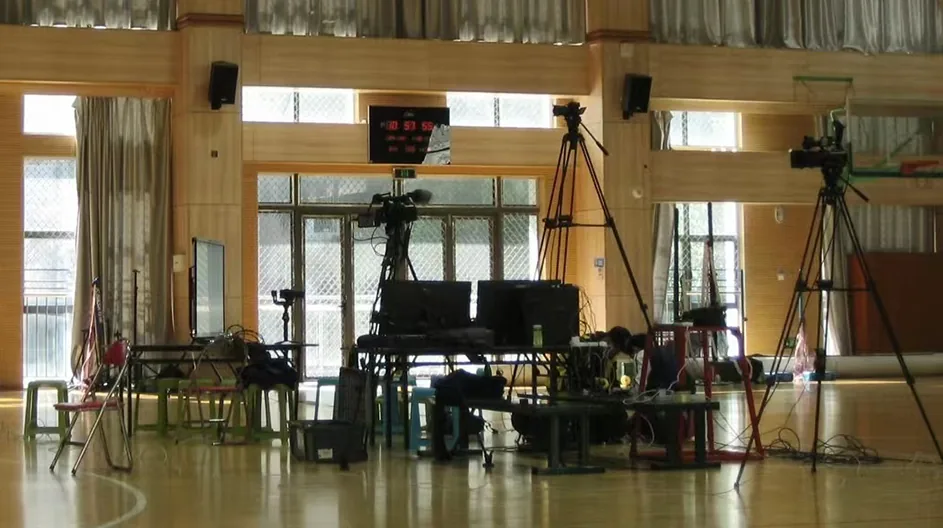
The audience in the venue and the audience online needed to follow the same event. Our student team delivered a five-camera production for two venue screens and an online stream.

The brief and my responsibility

The gala needed five-camera coverage for two venue screens and an online stream. Our student production team had to coordinate camera coverage, sound, programme graphics and the running order for both audiences.

As the overall on-site lead and live director, I coordinated the production with the arts team, backstage running-order team and supervising teachers. My responsibilities also included planning, crew scheduling, editing and review.

What I prepared

I reviewed earlier school-event recordings and larger gala workflows to plan camera coverage, graphics and transitions. I also prepared backup streaming options and emergency arrangements. The production plan covered the running order, crew responsibilities, holding screens and a separate delayed online output.

How we responded to problems

Production challenges and the team's response
ChallengeResponse
Audio and video were out of sync during rehearsalWe traced the problem to inconsistent frame-rate settings between the two computers, including PAL/NTSC settings. Adjusting them resolved the mismatch.
Radio communication was difficult in a noisy venueWe revised the communication plan between camera operators, the director and the production director.
A live configuration change disrupted the main workflowAn incompatible video-format setting caused a failure at the start of the show. The preconfigured backup took over while the main console was restarted and the workflow restored.

Outcome and learning

The prepared backup kept the programme on air while the main workflow was restored. We completed the broadcast and delivered the event recording that evening.

The experience reinforced the value of preparation: consistent settings, a tested backup and clear communication all matter during a live event. My responsibility as a lead was to consider those parts together.

Production setup

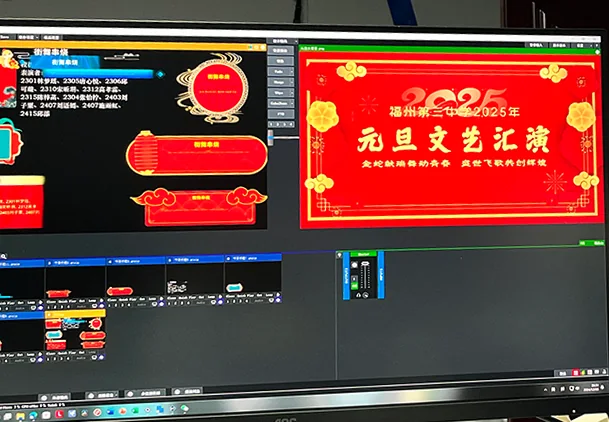
We created programme titles and lower thirds in Photoshop and vMix GT, with After Effects for transitions and closing credits. An Excel sheet supplied title information as the programme moved between performances.

The programme path
  1. 5 camera feeds

    Five camera feeds entered through Blackmagic SDI capture hardware, with audio from the mixing console through an XLR connection.

  2. Live direction

    The main workstation ran vMix to combine camera coverage, prepared graphics and transitions.

  3. Audience outputs

    NDI carried the programme to a second computer, where OBS supported checks and distribution to the venue screens and online stream. A prepared backup chain supported continuity.

Blackmagic SDIvMixNDIOBSVenue + online
Two audiences. One coordinated production.

Venue screens and an online stream, with a prepared backup chain.

When you watch

Watch the full event for camera coverage, programme graphics, transitions and the finished production credits.

View original & credits

03 / People & leadership

Help other students take responsibility for the work.

Recruitment, training & a year of student media

Making room for the next student storyteller.

I coordinated an organisation of 50 to 60 members, with around 30 active contributors, a deputy head and four team leaders. My responsibilities covered recruitment, training, project planning and editorial review.

The organisation and my responsibility

Trilobite TV at Fuzhou No. 3 High School had 50 to 60 members, with around 30 active contributors. I coordinated the station’s work with a deputy head and four team leaders, covering school news, sport, ceremonies, promotional films and live events.

I joined as a camera and post-production member in September 2023, took on day-to-day responsibility in May 2024 and was formally appointed Head in November 2024. My leadership responsibilities included recruiting and training members, planning projects and reviewing content.

Recruitment and training

I took part in recruitment and interviews, and led training in planning, storyboarding, editing and organising footage. The deputy head and relevant team leaders covered filming and technical operations.

Recruitment took place in September, followed by training for new members in the autumn and further departmental meetings and training in the spring.

How I organised the work

We used QQ for day-to-day communication. I kept key arrangements in Tencent Docs and spreadsheets, including schedules and responsibilities, so members could refer back to them after a conversation.

I developed project plans, worked on storyboards and delegated tasks to the relevant leaders when events or school commitments overlapped. This connected the preparation for a shoot with the work needed in post-production.

Editorial work and collaboration

I reviewed and revised scripts and school-news copy, wrote selected video scripts, and managed copy and publishing on QQ Space, also known as Qzone.

I worked with the sports, entertainment and societies departments, the arts team and Youth League supervising teachers to coordinate event plans, schedules and approvals with our production work.

The year’s results and next steps

I coordinated 48 student media projects in the 2024/25 academic year. Several major productions were delivered on the day, including sports-day coverage and the New Year’s Gala. These were deliveries by the station’s production teams.

Some news projects encountered missing footage and long turnaround, and some creative ideas were difficult to realise. These experiences pointed to further work on preparation, coordination and developing students who could plan and lead a production.

04 / Reliable delivery

Make the process understandable enough for a team to use.

200+ item equipment system · In use since December 2024

Good stories need a team that can get to work.

Inconsistent borrowing records made equipment difficult to trace and responsibility hard to establish. I introduced a JianDaoYun process to record how items moved between the station and its production teams.

The problem and my task

As the equipment collection grew, inconsistent borrowing records made it difficult to locate items and establish who was responsible for returning them. My task was to introduce a clear, traceable process that student production teams could use consistently.

What I introduced

I proposed, designed and introduced a JianDaoYun equipment-management process covering more than 200 items. It linked equipment records and barcodes with borrowing, returns and responsibility tracking.

The borrowing cycle
  1. Identify

    Create an equipment record and barcode so the physical item can be matched to its entry.

  2. Borrow

    Use the shared process to record the item leaving the station and establish who is responsible for it.

  3. Return

    Record the return and use the history to follow up when an item is missing or responsibility is unclear.

A traceable record for each item.

More than 200 items, with borrowing and returns linked to responsibility.

Getting the team to use it

I explained the reasons for the change in meetings and training, demonstrated the process in trial runs and worked with team leaders on adoption. I presented clearer records and responsibility tracking as practical reasons to use the system in everyday production.

Outcome and learning

The system has remained in use since December 2024, as confirmed in September 2026. It established a shared record of equipment movements and supported more standardised management.

Establishing responsibility still required follow-up. A shared system needs understandable procedures and consistent participation from the team to remain useful.

Leadership & impact

A year of student media.

The wider programme behind the four case studies.

2024/25 programme

September 2024

Recruitment and new-member training

Written assessment, interviews, a recruitment meeting and initial training established the new intake.

October 2024

Sport and event coverage

Sports-day highlights, a full football recording and swimming coverage. This work highlighted a need for wider sporting context and more usable coverage.

November–December 2024

News, music and performance

School news, a winter concert, the Top Ten Singers final and the New Year’s Gala required different schedules and production approaches.

March–April 2025

Sport, film and student activities

Basketball coverage, short-film work, social-practice highlights and coverage of societies and the sports festival.

May 2025

Celebration and encouragement

May Fourth promotional content and the coming-of-age / examination encouragement film.

Recorded turnaround

Selected project delivery times.

ProjectDelivery
Sports day: opening ceremony, highlights and footballAll delivered the same day
2025 New Year’s GalaDelivered that evening
Winter concertDelivered that weekend
Solo music and dance eventDelivered by Friday that week
Second-year high-school social-practice eveningDelivered two weekends later; the schedule overlapped with mid-term examinations

Reading the numbers carefully

I coordinated 48 projects during the year. Some material was grouped into multipart uploads and full-event recordings, and some event footage could not be released.

Those publication totals are not a like-for-like measure of production volume across years. The examples above show the range and turnaround of the work without treating upload count as a complete measure of impact.

My practice

How I approach the work.

Creative decisions, shared information and useful reflection.

Story & post-production

Colour can carry a story.

In a student short film about mental health, I used DaVinci Resolve to help express the protagonist’s movement from isolation towards connection. Power masks and keyframes let me adjust exposure and warmth shot by shot, alongside a shift from cool blue towards warmer amber.

I studied colour science and waveform monitoring to support those choices. The purpose of the technique was to make an emotional change visible. This short film is separate from the two event films linked below.

Communication & organisation

Give the team something to work from.

QQ carried daily conversations; Tencent Docs and spreadsheets held schedules, responsibilities and shared project information. My priority was to keep the arrangements that affected other people’s work easy to find.

Recruitment, interviews, training, scripts, storyboards, footage organisation and Qzone copy all formed part of my role. My experience with these tools gives me a practical basis for adapting to a new team’s working methods.

Learning beyond the station

See how other teams work.

Through school leadership, I secured an opportunity to visit Fuzhou Television Station and learn about a professional broadcast environment.

This was a visit to learn about a professional environment, alongside my own student production experience. Leading the school station taught me to connect that curiosity with practical questions about preparation, communication and responsibility.

At King’s

Make student life easier to connect with.

I am interested in content that helps students understand university life, discover opportunities and recognise their own experiences in the stories a university shares.

I would bring audience-focused planning, interviewing, filming, editing and live production experience, alongside the habit of coordinating with contributors and working towards an agreed deadline. I work in Mandarin Chinese and English.

Production toolsPremiere Pro · DaVinci Resolve · After Effects · Photoshop · Lightroom · vMix · OBS · NDI · Blackmagic workflows

Films & credits

See what I contributed.

Finished work, the relevant roles and where to verify them.

When I contribute directly to a video, I am credited as 黄心成 in its end credits or description under the relevant role. Production, editorial review, live direction and editing are different contributions; the roles above identify my involvement in each film.

The station’s channel contains work by the wider team. My leadership of the station does not mean I personally filmed or edited every upload. For the encouragement film, my credit is producer and editorial reviewer; for the gala, it includes live direction and editing.

Browse the station’s Bilibili channel

Let’s connect

Start with a story.

Xincheng Huang · BA Digital Media & Culture, King’s College London
Interested in student content, media production and event coverage.

Film preview